CaptureIQ workflow study
From Federal Opportunity Discovery to a 55-Page Proposal Package in 3 Minutes 41 Seconds
Federal proposal preparation is normally a multi-stage process involving opportunity discovery, qualification, competitive research, compliance review, technical writing, supporting documents, and multiple rounds of review.
In a measured CaptureIQ workflow, the platform completed the discovery and analysis process and generated a 55-page submission package in 221 seconds — 3 minutes 41 seconds.
This page documents what the system produced, what the timing includes, and what the result does and does not mean.
Measured CaptureIQ workflow
- Discover
- Analyze
- Decide
- Generate
- Validate
221 seconds~55 pages
What happened during the 221-second workflow?
CaptureIQ performed a combined workflow — not a single text-generation step. In the measured run, the platform:
- Searched the available federal opportunity inventory
- Identified relevant opportunities and listed candidate pursuits
- Applied company-fit analysis against the configured profile
- Retrieved opportunity context for downstream work
- Evaluated competitive and contractor signals where directory data was available
- Produced an executive decision view with pursue context and competitor matches
- Generated supporting proposal documents for review
- Assembled a multi-document submission package
- Made generated documents available for preview and download inside CaptureIQ
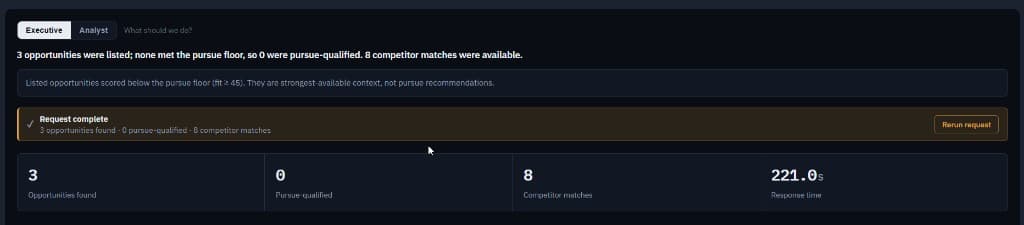
The workflow result screenshot above shows three opportunities surfaced, eight competitor matches returned, and a total response time of 221.0 seconds for the combined request. That timing includes retrieval, analysis, and document generation — not prose output alone.
What was included in the 55-page package?
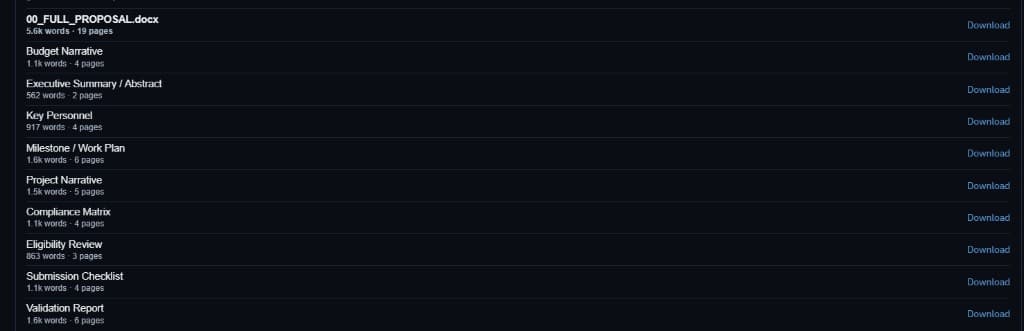
The measured run produced a multi-document proposal package totaling approximately 55 rendered pages. Individual document sizes from the run:
| Document | Approximate size |
|---|---|
| Full Proposal | 5.6K words / 19 pages |
| Budget Narrative | 1.1K words / 4 pages |
| Executive Summary / Abstract | 562 words / 2 pages |
| Key Personnel | 917 words / 4 pages |
| Milestone / Work Plan | 1.6K words / 6 pages |
| Project Narrative | 1.5K words / 5 pages |
| Compliance Matrix | 1.1K words / 4 pages |
| Eligibility Review | 863 words / 3 pages |
| Submission Checklist | 1.1K words / 4 pages |
| Validation Report | 1.6K words / 6 pages |
Why measure discovery-to-package time instead of generation speed alone?
Measuring only AI writing speed misses most of the capture workflow. The relevant business process starts before proposal writing:
Opportunity discovery → qualification → analysis → competitive context → decision support → document generation → compliance and supporting artifacts → package review
The 221-second measurement covers that broader path in one CaptureIQ request. Conventional federal proposal preparation often spans multiple functions — capture, market research, compliance, technical writing, and management review — with substantial manual coordination between each stage.
For context on how much calendar time agencies typically allow between posting and deadline, see the Federal Proposal Timeline Benchmark. That study measures solicitation response windows; this page measures one CaptureIQ workflow from discovery through a generated package.
Does faster proposal generation mean canned output?
No. Simple CaptureIQ queries — such as catalog counts or directory lookups — may return in seconds because they require limited retrieval and formatting.
Large work-product requests are different. They can require multiple data retrieval steps, fit calculations, contextual analysis, document generation, validation, and file rendering. The measured run falls into that second category: a multi-stage workflow that produced structured artifacts, not a single chat reply.
CaptureIQ is designed to reduce unnecessary latency without pretending that complex capture work and simple lookups are equivalent.
Where human review still matters
Generated proposal materials are work products for review, refinement, validation, and authorization. They are not submission-ready without accountable human oversight.
Users remain responsible for:
- Verifying solicitation requirements and evaluation factors
- Confirming eligibility and set-aside posture
- Validating factual representations and past performance claims
- Reviewing technical content, staffing, and management approach
- Checking pricing and budget assumptions
- Approving final submissions through the required agency channel
CaptureIQ does not autonomously submit proposals. See federal proposal automation boundaries for what should and should not be automated in GovCon proposal work.
How CaptureIQ approaches federal proposal automation
CaptureIQ connects federal opportunity discovery, qualification, and governed document generation in one workflow. Teams can search and monitor notices on federal opportunities, set up free opportunity alerts, evaluate fit inside Intelligence, and move qualified pursuits toward reviewable packet materials on the CaptureIQ product overview.
For AI-assisted RFP drafting under human control, see AI RFP proposal software. Pricing and plan limits are published on CaptureIQ pricing.
Methodology
- Measurement type: observed CaptureIQ workflow
- Elapsed time: 221 seconds
- Output: approximately 55 rendered pages
- Workflow included: opportunity discovery, analysis, competitor context, and document generation
- Sample: one measured run
- Performance varies based on query complexity, data availability, document scope, model/provider latency, and system conditions
- Generated materials require human review before any submission decision
See what CaptureIQ can do with your opportunity pipeline
Search federal opportunities, evaluate fit, and move from discovery toward a reviewable capture and proposal package in one workflow.