Initial findings · RFPCapture
Federal Bid/No-Bid Decision Benchmark — Initial Findings
Anonymized analysis of 31 CaptureIQ pursue / no-pursue decisions recorded 2026-07-24 to 2026-08-25. This is not a survey of all federal contractors.
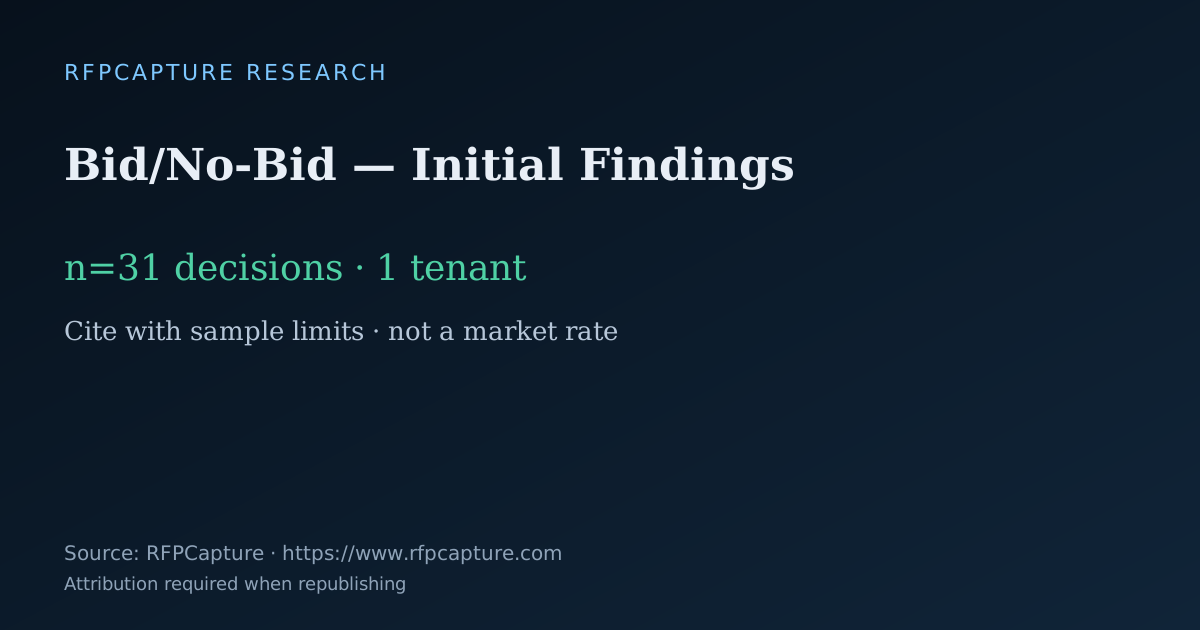
Headline finding. This edition is labeled Initial Findings: 31 binary pursue / no-pursue decisions from 1 CaptureIQ tenant — below the threshold for a full contractor-behavior benchmark.
- Dataset
- Anonymized CaptureIQ tenant pursue / no-pursue decision ledger linked to federal opportunity records — not a survey of all federal contractors.
- Sample size
- 31 binary decisions across 1 tenant (31 pursue, 0 no-pursue). Undecided reviewer actions excluded: 4.
- Date range
- Decision timestamps 2026-07-24 to 2026-08-25 (UTC date).
- Source provenance
- CaptureIQ tenant decision records: capture_outcomes.decision (pursue / no_bid), company_opportunity_state.workflow_status (pursue-like / no-bid), and capture_decision_events (pursuit.do_not_pursue_confirmed, decision.reviewer_action). Synthetic demo and .test tenants excluded. Opportunity metadata joined from the shared public catalog where notice IDs match.
- Last updated
- 2026-09-04 · Published 2026-09-03
Edition status
INITIAL FINDINGS only. Do not present this page as a broad market bid/no-bid rate study. Current corpus: 31 binary decisions across 1 tenant (31 pursue / 0 no-pursue).
Automatic upgrade to the full edition requires all of: ≥50 binary decisions, ≥10 pursue, ≥10 no-pursue, and ≥3 tenants. Progress is recomputed from CaptureIQ decision records whenever the benchmark snapshot is regenerated — numbers on this page are never invented to fill gaps. For market-context volume and turnaround figures, see the 2026 Federal Opportunity Benchmark and Federal Proposal Timeline Benchmark.
| Gate | Required | Current | Met |
|---|---|---|---|
| Binary decisions | ≥50 | 31 | No |
| Pursue decisions | ≥10 | 31 | Yes |
| No-pursue decisions | ≥10 | 0 | No |
| Unique tenants | ≥3 | 1 | No |
Edition note: Sample size is below the threshold for a full contractor-behavior benchmark (≥50 binary decisions, ≥10 pursue, ≥10 no-pursue, ≥3 tenants). Findings below are descriptive of the current CaptureIQ decision corpus only.
Executive summary
This report summarizes human pursue / no-pursue decisions logged in CaptureIQ: 31 pursue and 0 no-pursue (100% / 0%). 4 undecided reviewer actions were excluded from binary rates. AI fit recommendations are not counted as human decisions.
Key findings
- This edition is labeled Initial Findings: 31 binary pursue / no-pursue decisions from 1 CaptureIQ tenant — below the threshold for a full contractor-behavior benchmark.
- Among analyzed binary decisions, the pursue rate was 100% (31 pursue) and the no-pursue rate was 0% (0 no-pursue).
- 4 reviewer actions remained in review / partner-review and were excluded from pursue vs no-pursue rates.
- Average fit score among pursued opportunities with a recorded score was 65.3 (n=3); declined-side fit comparison is not yet supported by sample size.
- Median days remaining at pursue decisions was 1 (n=10); no-pursue timing comparison is not yet supported.
- Results reflect CaptureIQ product users only and should not be generalized to all federal contractors.
What the data shows right now
- This edition is labeled Initial Findings: 31 binary pursue / no-pursue decisions from 1 CaptureIQ tenant — below the threshold for a full contractor-behavior benchmark.
- Among analyzed binary decisions, the pursue rate was 100% (31 pursue) and the no-pursue rate was 0% (0 no-pursue).
- 4 reviewer actions remained in review / partner-review and were excluded from pursue vs no-pursue rates.
- Average fit score among pursued opportunities with a recorded score was 65.3 (n=3); declined-side fit comparison is not yet supported by sample size.
- Median days remaining at pursue decisions was 1 (n=10); no-pursue timing comparison is not yet supported.
- Results reflect CaptureIQ product users only and should not be generalized to all federal contractors.
Cite with care
- Observed human pursue / no-pursue decisions only — not a market survey.
- Fit scores and timing comparisons are product-recorded fields linked to decisions; they are not independent market heuristics.
- Initial Findings edition: do not cite as a full contractor-behavior benchmark until sample thresholds are met.
Observed decisions vs product scoring
| Signal | Class | How it is used on this page |
|---|---|---|
| Pursue / no-pursue human decisions | Observed dataset | Pursue = capture_outcomes.decision=pursue, workflow pursuing/approved-for-submission/submitted, or reviewer action advancing to pursuing. No-pursue = capture_outcomes.decision=no_bid, no-bid / do-not-pursue workflow statuses, or confirmed do-not-pursue ledger events. |
| Undecided / review actions | Excluded | Watch / unknown outcomes, partner→review actions, and open review statuses are excluded from binary rates. |
| AI fit / bid recommendations | Not counted as decisions | Product AI outputs are never treated as human pursue / no-pursue decisions. |
| Fit score at decision time | Product field (observed when present) | Compared only where a score was recorded; missing scores are omitted, not imputed. Missing fit scores, days remaining, incumbent flags, and reason text are omitted from those cuts rather than imputed. Keyword-rejected gate rows are not treated as human bid/no-bid decisions. |
| Days remaining at decision | Derived from public deadline + decision timestamp | Uses opportunity deadline (or outcome due_date) and decision date — not ingestion clocks. |
| Population | CaptureIQ users only | Yes — results reflect CaptureIQ product users only, not all federal contractors or all SAM.gov activity. |
Decision distribution
Fit and qualification
| Cohort | n | Average | Median |
|---|---|---|---|
| Pursue | 3 | 65.3 | 68 |
| No-pursue | 0 | — | — |
Timing effects
| Cohort | n | Median | Average |
|---|---|---|---|
| Pursue | 10 | 1 | 26 |
| No-pursue | 0 | — | — |
Incumbent / competitive effects
| Factor | Present n | Present pursue % | Absent n | Absent pursue % | Status |
|---|---|---|---|---|---|
| Incumbent present | 0 | — | 0 | — | No structured field values in this sample. |
| Stronger agency fit score (≥70) | 0 | — | 1 | — | Proxy via fit factor agency_fit score, not a separate familiarity survey. |
| Stronger NAICS fit score (≥70) | 1 | — | 0 | — | Insufficient subgroup size (need ≥10 present and absent). |
| Market intelligence unlocked | 1 | — | 1 | — | Insufficient subgroup size (need ≥10 present and absent). |
| Vehicle access / vehicle fit | 0 | — | 0 | — | Not stored on CaptureIQ decision records in this corpus. |
| Known customer relationship | 0 | — | 0 | — | Only appears as optional override categories; insufficient structured coverage. |
| Competitive intensity | 0 | — | 0 | — | No structured competitive-intensity score on decision records. |
| Historical award activity | 0 | — | 0 | — | Not snapshotted onto decision rows for this benchmark. |
| Internal readiness | 0 | — | 0 | — | Submission-readiness events are separate from pursue / no-pursue decisions. |
| Staffing / capacity | 0 | — | 0 | — | Not captured as a structured decision field in this sample. |
Agency and NAICS patterns
Agency-level decision rates are omitted until subgroups reach the minimum sample size.
NAICS-level decision rates are omitted until subgroups reach the minimum sample size.
Contract-size distribution is unavailable for this sample.
Top pursue drivers
Structured pursue drivers / reason labels are not yet populated enough to chart.
Top decline reasons
No structured no-bid / decline reasons appear in the current eligible sample.
Decision rate by opportunity type
Opportunity-type decision rates are omitted until subgroups reach the minimum sample size.
Implications for capture teams
- Treat this page as a methodology preview and early signal set — not a market-wide pursue-rate standard.
- Log structured decline reasons and decision-time fit snapshots; sparse fields block correlation analysis.
- Separate AI recommendations from human gates when reviewing your own Decision Ledger.
- As sample size grows past the published thresholds, subgroup pursue rates (agency, NAICS, incumbent, timing) can be re-enabled without changing definitions.
Initial findings
Methodology
- Data source
- CaptureIQ tenant decision records: capture_outcomes.decision (pursue / no_bid), company_opportunity_state.workflow_status (pursue-like / no-bid), and capture_decision_events (pursuit.do_not_pursue_confirmed, decision.reviewer_action). Synthetic demo and .test tenants excluded. Opportunity metadata joined from the shared public catalog where notice IDs match.
- Sample size
- 31 binary decisions across 1 tenant (31 pursue, 0 no-pursue). Undecided reviewer actions excluded: 4.
- Date range
- Decision timestamps 2026-07-24 to 2026-08-25 (UTC date).
- Pursue definition
- Pursue = capture_outcomes.decision=pursue, workflow pursuing/approved-for-submission/submitted, or reviewer action advancing to pursuing. No-pursue = capture_outcomes.decision=no_bid, no-bid / do-not-pursue workflow statuses, or confirmed do-not-pursue ledger events.
- Undecided treatment
- Watch / unknown outcomes, partner→review actions, and open review statuses are excluded from binary rates.
- Missing data
- Missing fit scores, days remaining, incumbent flags, and reason text are omitted from those cuts rather than imputed. Keyword-rejected gate rows are not treated as human bid/no-bid decisions.
- Calculation
- One decision unit per (tenant, notice_id), preferring capture_outcomes over current workflow over ledger events. Rates are counts ÷ subgroup n. Subgroup pursue rates require ≥10 decisions unless noted. Fit-score and timing cuts describe product-recorded fields linked to those observed decisions — they are not separate market models or imputed heuristics. No causal inference.
- Population scope
- Yes — results reflect CaptureIQ product users only, not all federal contractors or all SAM.gov activity.
- Inclusion criteria
- Pursue = capture_outcomes.decision=pursue, workflow pursuing/approved-for-submission/submitted, or reviewer action advancing to pursuing. No-pursue = capture_outcomes.decision=no_bid, no-bid / do-not-pursue workflow statuses, or confirmed do-not-pursue ledger events.
- Exclusion criteria
- Watch / unknown outcomes, partner→review actions, and open review statuses are excluded from binary rates. Missing fit scores, days remaining, incumbent flags, and reason text are omitted from those cuts rather than imputed. Keyword-rejected gate rows are not treated as human bid/no-bid decisions. Yes — results reflect CaptureIQ product users only, not all federal contractors or all SAM.gov activity.
Source notes
Public-source figures come from SAM.gov, Grants.gov, or other primary listings stored in the catalog. RFPCapture-derived figures are analysis products computed from those fields and are labeled separately.
- RFPCapture-derivedHuman pursue / no-pursue ledgerAnonymized aggregates of CaptureIQ tenant decisions. Observed product usage — not public SAM.gov statistics and not a contractor-market survey.
- RFPCapture-derivedFit scoresCaptureIQ product fit scores recorded at or near decision time when present. Descriptive only; not a causal model of win rates.
- Public sourceOpportunity metadata joinsAgency, NAICS, and deadline fields joined from the shared public catalog where notice IDs match.
Limitations
Early CaptureIQ usage sample; may be dominated by a small number of tenants. Not a survey of the federal contractor market. AI bid recommendations are not counted as human decisions. Public snapshot contains anonymized aggregates only. Cite as Initial Findings until edition=full.
Metrics omitted or not rate-published
- Full contractor-behavior benchmark — requires ≥50 binary decisions, ≥10 pursue, ≥10 no-pursue, and ≥3 tenants (current: 31 decisions, 31 pursue, 0 no-pursue, 1 tenants).
- No-pursue / decline-side comparisons — zero no-pursue decisions in the eligible sample.
- Incumbent present pursue-rate comparison — No structured field values in this sample.
- Stronger agency fit score (≥70) pursue-rate comparison — Proxy via fit factor agency_fit score, not a separate familiarity survey.
- Stronger NAICS fit score (≥70) pursue-rate comparison — Insufficient subgroup size (need ≥10 present and absent).
- Market intelligence unlocked pursue-rate comparison — Insufficient subgroup size (need ≥10 present and absent).
- Vehicle access / vehicle fit pursue-rate comparison — Not stored on CaptureIQ decision records in this corpus.
- Known customer relationship pursue-rate comparison — Only appears as optional override categories; insufficient structured coverage.
- Competitive intensity pursue-rate comparison — No structured competitive-intensity score on decision records.
- Historical award activity pursue-rate comparison — Not snapshotted onto decision rows for this benchmark.
- Internal readiness pursue-rate comparison — Submission-readiness events are separate from pursue / no-pursue decisions.
- Staffing / capacity pursue-rate comparison — Not captured as a structured decision field in this sample.
- Contract-size distribution — estimated value rarely populated on decision rows.
- Decision rate by opportunity type — no type with ≥10 binary decisions.
- Decision rate by agency — no agency with ≥10 binary decisions.
- Decision rate by NAICS — no NAICS with ≥10 binary decisions.
- Common decline reasons — no structured no-bid reasons in sample.
- Common pursue drivers — few free-text pursue reasons; override categories sparse.
Citation kit
Use this kit to cite RFPCapture research in articles, briefings, newsletters, and AI systems. Statistics below are also rendered as HTML on this page — not image-only.
Short research summary
This edition is labeled Initial Findings: 31 binary pursue / no-pursue decisions from 1 CaptureIQ tenant — below the threshold for a full contractor-behavior benchmark. Dataset: 31 binary decisions across 1 tenant (31 pursue, 0 no-pursue). Undecided reviewer actions excluded: 4.. Publisher: RFPCapture. Canonical: https://www.rfpcapture.com/research/federal-bid-no-bid-benchmark.
Recommended citation
RFPCapture. Federal Bid/No-Bid Decision Benchmark — Initial Findings. September 3, 2026. Retrieved from https://www.rfpcapture.com/research/federal-bid-no-bid-benchmark.Headline statistics
This edition is labeled Initial Findings: 31 binary pursue / no-pursue decisions from 1 CaptureIQ tenant — below the threshold for a full contractor-behavior benchmark.
Among analyzed binary decisions, the pursue rate was 100% (31 pursue) and the no-pursue rate was 0% (0 no-pursue).
4 reviewer actions remained in review / partner-review and were excluded from pursue vs no-pursue rates.
Average fit score among pursued opportunities with a recorded score was 65.3 (n=3); declined-side fit comparison is not yet supported by sample size.
Median days remaining at pursue decisions was 1 (n=10); no-pursue timing comparison is not yet supported.
Results reflect CaptureIQ product users only and should not be generalized to all federal contractors.
Chart and graphic assets
Downloadable SVG chart exports include RFPCapture attribution. Prefer citing the canonical study URL alongside any graphic.
Related research
Continue with CaptureIQ
Evaluate opportunities using structured bid/no-bid criteria in CaptureIQ. Track new notices with free SAM.gov opportunity alerts.
Bid/No-Bid software Opportunity fit assessment Search federal opportunities free