FEDERAL PROPOSAL ECONOMICS
How Much Does It Cost to Prepare a Federal Proposal?
There is no honest universal dollar amount. Federal proposal cost depends on solicitation complexity, how many volumes and reviewers you need, pricing depth, teaming, graphics, compliance work, and how much qualified labor your team spends before submission. Use the frameworks below to estimate your own budget—not a vendor quote dressed as an industry average.
A practical planning model: Estimated proposal cost ≈ internal labor + external support + graphics + pricing support + review cycles + compliance/administration + other pursuit costs (each line varies by solicitation). The stage table and labor scenarios on this page are illustrative only (see methodology). They help you multiply hours × blended rates for one submission package—not to imply every pursuit costs the same.
What Drives Federal Proposal Cost?
Cost rises when submission instructions, evaluation factors, or pricing rules expand the work surface. The list below is a checklist for estimating—not a promise that every item applies to every notice.
- Solicitation complexity and page-count / volume requirements
- Technical depth and number of contributors or SMEs
- Pricing volume complexity and subcontractor / teaming support
- Graphics, forms, and compliance / Section L–M obligations
- Color-team and executive review cycles
- Proposal manager coordination and outside consultants
- Internal loaded labor rates versus external proposal support
- Schedule compression and incumbent / competitive research depth
Before major drafting spend, teams often qualify the pursuit and organize requirements—see RFP capture and federal proposal planning for how software can structure that path without replacing human judgment.
Typical Cost Components
A contractor may need to discover the opportunity, download and organize solicitation documents, determine eligibility, analyze requirements, build a compliance matrix, evaluate fit, research the incumbent and competitors, develop a capture strategy, create a work plan, prepare technical and management narratives, develop pricing/budget information, identify key personnel, assemble supporting documentation, validate compliance, review the final package, and prepare the submission. Each step consumes skilled time—often before the team agrees the pursuit is worth a full proposal investment.
How Proposal Complexity Changes Cost
| Stage | Low | Mid | High |
|---|---|---|---|
| Opportunity discovery and document collection | 6 hrs | 12 hrs | 22 hrs |
| Initial qualification / bid-no-bid review | 4 hrs | 8 hrs | 14 hrs |
| Solicitation analysis | 10 hrs | 18 hrs | 32 hrs |
| Compliance matrix | 6 hrs | 12 hrs | 24 hrs |
| Capture / competitive research | 6 hrs | 14 hrs | 28 hrs |
| Technical approach | 12 hrs | 24 hrs | 56 hrs |
| Management / staffing approach | 8 hrs | 16 hrs | 32 hrs |
| Past performance / experience | 6 hrs | 12 hrs | 24 hrs |
| Pricing / budget narrative | 8 hrs | 18 hrs | 36 hrs |
| Executive summary | 4 hrs | 8 hrs | 14 hrs |
| Supporting forms / documentation | 6 hrs | 12 hrs | 26 hrs |
| Quality review | 6 hrs | 10 hrs | 22 hrs |
| Final assembly / submission preparation | 4 hrs | 10 hrs | 20 hrs |
| Total illustrative hours | 86 hrs | 174 hrs | 350 hrs |
How to Estimate Your Proposal Budget
Proposal labor cost = total labor hours × blended hourly labor cost. Pair the stage totals above with the rates below to model internal labor—not software subscriptions or external consultant invoices, which sit in separate line items.
Illustrative loaded labor-cost scenarios:
| Blended rate | Estimated labor cost |
|---|---|
| $75/hour | $13,050.00 |
| $100/hour | $17,400.00 |
| $125/hour | $21,750.00 |
| $150/hour | $26,100.00 |
Example: 100 hours × $100/hour = $10,000.00; 200 hours × $100/hour = $20,000.00.
Internal Team vs Outside Proposal Support
Internal teams carry loaded salaries, fringe, and opportunity cost when SMEs are pulled from billable work. Outside proposal consultants, graphics shops, and pricing specialists add cash cost but can compress calendar time. Many pursuits blend both; your estimate should name which hours are internal versus vendor-backed.
Hidden Costs in Federal Proposal Development
The hidden cost of a pursuit often includes senior leadership review, capture management, solution architecture, pricing, compliance checking, document management, research, opportunity qualification, incumbent analysis, proposal coordination, final QA, context switching, and pursuing opportunities that should have been rejected earlier. Reducing unproductive pursuit effort can matter as much as accelerating writing.
What Can One Submission Package Represent?
Assume 150 total labor hours and $100/hour blended loaded labor cost. Estimated internal labor: $15,000.00. This is an illustration — not a claim that every federal proposal costs $15,000.
| Total hours | Estimated internal labor |
|---|---|
| 50 hours | $5,000.00 |
| 100 hours | $10,000.00 |
| 150 hours | $15,000.00 |
| 250 hours | $25,000.00 |
When Proposal Software Reduces Administrative Work
CaptureIQ combines federal opportunity discovery, fit analysis, opportunity qualification, competitor context, capture intelligence, compliance analysis, structured proposal generation, packet generation, validation, and review workflow in one governed path.
Human review, pricing judgment, technical validation, customer knowledge, and final submission responsibility remain essential. Software compresses organization and initial production — it does not remove accountability or guarantee savings. For compliance mapping depth, see RFP compliance matrix software and government contracting proposal software on neighboring product pages.
Measured CaptureIQ proposal package run
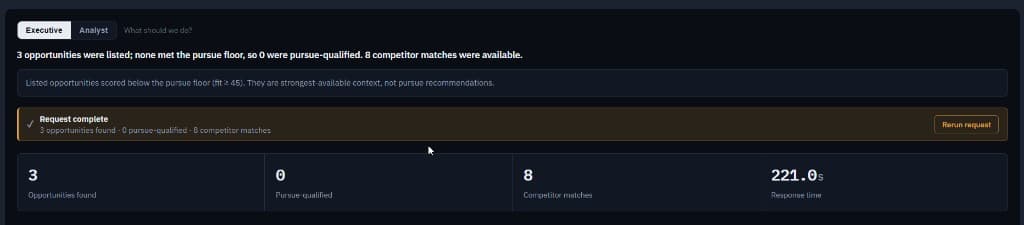
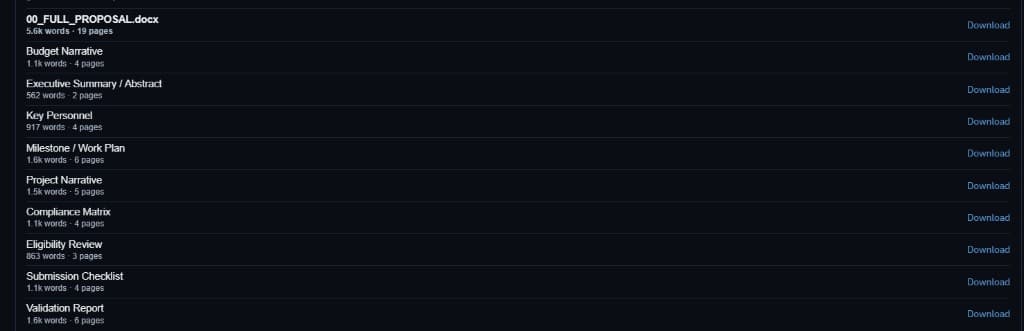
In one measured CaptureIQ run, the system moved from opportunity analysis to an approximately 55-page submission package in 221 seconds (3 minutes 41 seconds). That does not mean a federal proposal is ready to submit without human review. It demonstrates the amount of initial analysis, organization, and document production that can be compressed into minutes.
| Document | Words | Pages |
|---|---|---|
| Full Proposal | 5.6K words | 19 pages |
| Budget Narrative | 1.1K words | 4 pages |
| Executive Summary / Abstract | 562 words | 2 pages |
| Key Personnel | 917 words | 4 pages |
| Milestone / Work Plan | 1.6K words | 6 pages |
| Project Narrative | 1.5K words | 5 pages |
| Compliance Matrix | 1.1K words | 4 pages |
| Eligibility Review | 863 words | 3 pages |
| Submission Checklist | 1.1K words | 4 pages |
| Validation Report | 1.6K words | 6 pages |
What Does CaptureIQ Cost Per Proposal Packet?
Published CaptureIQ plans include a monthly completed proposal packet allowance. At full monthly capacity, software cost per packet equals monthly plan price divided by included packet capacity.
| Plan | Monthly price | Completed packets / month | At full capacity |
|---|---|---|---|
| Starter | $249.00 | 4 | $62.25 / packet |
| Scout | $499.00 | 10 | $49.90 / packet |
| Pursuit | $1,299.00 | 30 | $43.30 / packet |
| Command | $2,499.00 | 75 | $33.32 / packet |
At full Scout capacity, the software cost is as little as $49.90 per completed proposal packet. This is a capacity-based software cost calculation. It does not mean every customer will produce 10 packets per month, nor does it include the organization's remaining human review, pricing, technical, and submission labor.
The Question Is Not Just “What Does the Software Cost?”
| Workflow step | Traditional / manual | CaptureIQ-assisted |
|---|---|---|
| Opportunity discovery | Manual search, alerts, and intake | SAM.gov-centered discovery with qualification workflow |
| Document collection | Manual download and folder organization | Structured document intake tied to the pursuit |
| Requirement analysis | Analyst reads and tags sections manually | Compliance-oriented analysis with traceability |
| Compliance organization | Spreadsheet matrix maintained by hand | Structured compliance matrix generation |
| Capture research | Separate tools and ad hoc notes | Competitive and market context in the workflow |
| Proposal drafting | Blank-page writing from scratch | Structured draft generation from company evidence |
| Packet assembly | Manual merge of forms and narratives | Review-ready packet generation |
| Review | Email chains and version confusion | Governed review workflow with audit trail |
| Human approval | Required in both paths | Required — CaptureIQ does not auto-submit |
Evaluate software cost against the amount of skilled work being compressed — not simply against another subscription line item.
Already Paying for Another GovCon Platform?
A contractor may recognize the value of a new capture or proposal platform but still have months remaining on an existing software contract. That creates a second economic problem: paying for two systems during the transition period.
CaptureIQ's Make-Whole Offer is designed to address that overlap. CaptureIQ does not buy out the incumbent contract, reimburse the incumbent vendor, or assume the incumbent obligation. Eligible customers can begin using CaptureIQ while their existing contract finishes, with CaptureIQ billing structured according to approved Make-Whole terms.
Illustrative Make-Whole example
Scout: $499.00/month. Existing contract remaining: 6 months. If current incumbent monthly cost is at least $499.00, Make-Whole value: $499.00 × 6 = $2,994.00.
The customer can begin using CaptureIQ during those 6 months without paying overlapping CaptureIQ charges during the approved overlap period. The incumbent obligation is not eliminated.
Related proposal resources: Federal proposal planner · Compliance matrix · Proposal workspace · Federal Proposal Timeline Benchmark (response windows) · Federal Opportunities · Opportunity Alerts
FAQ
- How much does it cost to prepare a federal proposal?
- There is no single number. Cost depends on solicitation complexity, team size, pricing requirements, and how much qualified labor goes into discovery, analysis, writing, pricing, review, and submission assembly. This page uses transparent planning assumptions so you can model time × blended labor cost for one submission package.
- How long does it take to prepare a government proposal?
- Timelines vary widely. Some pursuits compress early analysis when requirements are well understood; complex RFPs can require substantially more review, pricing, and compliance work. Use the stage table on this page as an illustrative planning model, not a benchmark claim.
- How many people are typically involved in an RFP response?
- Even a lean pursuit may involve capture or BD, a proposal manager, subject-matter experts, pricing support, and senior review. Larger efforts add solution architects, contracts staff, graphics, and multiple reviewers. The labor model here reflects total skilled hours, not headcount.
- What is the cost per proposal using CaptureIQ?
- CaptureIQ plans include a monthly completed proposal packet allowance. At full monthly capacity, software cost per packet equals plan price divided by included packet capacity — for example Scout at published pricing. That is a capacity-based software calculation and does not replace remaining human review, pricing, or submission labor.
- Can AI write an entire federal proposal?
- No responsible workflow should treat AI output as submission-ready without human review. CaptureIQ can accelerate discovery, organization, drafting, and packet assembly, but pricing judgment, technical validation, customer knowledge, and final submission responsibility remain essential.
- Does CaptureIQ eliminate human proposal review?
- No. CaptureIQ is designed for governed capture and proposal workflow with human review, validation, and authorization before anything is treated as ready to submit.
- What if I already have a GovCon software contract?
- Many contractors want to switch platforms before an incumbent contract ends. That can create overlapping software cost during the transition. CaptureIQ's Make-Whole Offer addresses eligible overlap under approved terms — it does not buy out or reimburse the incumbent vendor.
- Does CaptureIQ buy out my current software contract?
- No. CaptureIQ does not buy out, reimburse, or assume your incumbent software obligation. Eligible Make-Whole terms can structure CaptureIQ billing so you can begin using CaptureIQ during an approved overlap period according to your signed agreement.
- How does the CaptureIQ Make-Whole Offer work?
- After you calculate your offer, verify your incumbent commitment, sign the Make-Whole Agreement, and add a payment method, CaptureIQ reviews the submission. If approved, CaptureIQ activates subscription terms designed to address overlapping CaptureIQ charges during your remaining incumbent period. Terms require verification and approval.
Methodology & disclosure
- Labor-hour ranges on this page are illustrative planning models, not measured industry averages.
- Blended hourly labor rates are selectable assumptions for education only.
- Actual proposal cost varies by solicitation, team, and customer knowledge.
- The 3 minutes 41 seconds / 221 seconds CaptureIQ case study reflects one measured product run, not a guarantee for every opportunity.
- Software-generated proposal content requires human review before submission decisions.
- Make-Whole Offer terms are subject to verification, agreement, and approval.